
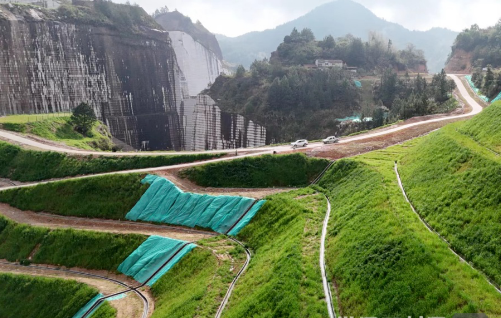
On the map of China’s stone industry, Hubei Sesame White and Shandong White Granite are already renowned, occupying an important position in the industry thanks to their superior resources. However, few know that what truly rewrote the landscape of China’s stone mining from a technological perspective and profoundly reshaped the entire industry’s development trajectory was not these long-established production areas, but a mine in Gutian, Fujian, that had been shut down for ten years—the Hetang Taohuahong Mine.
This mine is remembered not for the rarity of its stone varieties or the abundance of its reserves, but for a group of ordinary Gutian craftsmen who used their wisdom to overcome difficulties and invent mining equipment that revolutionized the industry. In 1998, the world’s first diesel-powered rock saw was born on this land, sweeping across the country in just three years, enabling a leap forward in China’s stone mining efficiency, even surpassing similar technologies in Europe and America. Today, the technological origins of mainstream mining equipment used in mines across China can be traced back to this long-dormant mine, which continues to “dominate” China’s stone industry with its intangible technological legacy.
I. Survival in Dire straits: The Unbridled Growth of the Stone Industry in Hetang
The stone industry in Hetang Town, Gutian County, began in a period of immense hardship. In 1991, Singapore Hualian Stone Co., Ltd. was registered in Hetang, officially marking the beginning of the local stone industry. The mining methods at that time were shockingly primitive—workers could only select scattered “isolated stones” in the mountains, relying on brute force—swinging sledgehammers and inserting steel chisels—to split the stone. This was not only inefficient, but also left them helpless in the face of the vast mineral deposits within the mountains, only able to sigh in despair.
In 1995, the stone industry workers of Hetang began to try to break through these difficulties, exploring a new model of blasting and mining raw stone blocks on sheer cliffs. Within a two-kilometer stretch of the “Biding” mountain range, more than a dozen mining sites were scattered. Because transportation roads could not be built at either end of the mountain, the ore in the middle area remained dormant, difficult to transport. Faced with this dire situation, the people of Hetang displayed astonishing creativity: they designed and built cable cars (locally known as “sky cranes”), establishing an aerial transport route to steadily slide four-ton blocks of raw material down the hundred-meter-high cliff.
Back then, the Hetang mines were a scene of both spectacular and perilous activity: several cable cars shuttled through the air, huge blocks of raw material slowly sliding down steel cables, carrying the livelihoods and hopes of the local people. While this method improved mining efficiency to some extent, it was accompanied by extremely high safety risks, and accidents became commonplace. Even more regrettable was that the traditional “fire-cutting mining” method had an extremely low yield, only about 20%, with most of the precious mineral resources cracked and destroyed in the shockwaves of blasting, resulting in irreparable waste. In dire straits, a technological revolution that would determine the fate of the industry was quietly brewing.
II. Rewriting History: From Repairman to Industry Innovator
Faced with the inefficiency, high risk, and waste of traditional mining methods, several skilled craftsmen in Hetang Town conceived a bold, almost insane, idea: could a rotating saw blade be used to cut stone directly in the mine, replacing brute force blasting and fire cutting?
According to Stone.com: Yu Shentui, an ordinary mechanical repairman in Hetang Town, had long dealt with tractor repair and machinery modification, possessing a keen intuition for mechanical principles. In the latter half of 1997, while using an angle grinder to cut thin stone slabs, a sudden inspiration struck him: if the small saw blade of the angle grinder could cut thin slabs, wouldn’t a large circular saw allow for the direct cutting of entire blocks of stone in the mine? This idea became the starting point for rewriting the history of stone mining in China.
In the days that followed, Yu Shentui immersed himself in the mine, meticulously observing every detail of the workers’ stone-cutting process, recording the texture of the ore body and the difficulties of mining. Back home, he would repeatedly ponder and draw blueprints, refining every core element of the saw machine, including its rotation, lifting, and movement. Soon after, Chen Caidi, who manufactured mast cranes, learned of his ideas and proactively joined the research and development team. The two worked together to overcome technical challenges, complementing each other’s strengths and moving forward side-by-side.
In 1998, the first diesel-powered single-arm circular saw quarry machine was officially launched. However, the road to innovation is never smooth, and the trial run was fraught with difficulties. Initially, during trials at the Xiazhangyang mining area, a series of problems arose: the ore deposit surface required repeated manual leveling, the fixing and connection of the steel rails were extremely difficult, and an improperly designed traction rope caused instability in the saw machine’s operation… Within just six months, this “prototype” was halted by the mine owner, and the research and development stalled.
But the people of Hetang did not give up. In 1999, Yu Shentui and Liu Zhongyu collaborated to continue their research and development efforts, focusing on overcoming the core problem of slow saw feed in saws. By adjusting the saw blade linear speed and optimizing the cutter head depth, they finally achieved a breakthrough. Simultaneously, Chen Caidi and Huang Yuzhang’s collaborative development of a motor-driven saw also yielded significant progress in the Xiweiyang mining area. They made revolutionary improvements to the entire system: replacing the heavy iron rails with lightweight small steel rails, replacing cumbersome drilling with mortise and tenon joints, and designing the machine’s wheel base as a height-adjustable type, completely solving the problem of manually leveling the mine surface and enabling direct sawing production. More importantly, a turntable was added to the frame, allowing for flexible rail rotation and 360-degree sawing in any direction, adapting to the mining needs of different ore bodies.
These technological breakthroughs led to explosive profits. The Xiweiyang mine, using the improved circular saw quarrying machine, achieved profits exceeding one million yuan that year, setting a record for the highest annual profit in the town’s mining history. The people of Gutian have demonstrated the immense power of mechanized mining with tangible results, opening a new door for the upgrading of China’s stone industry.
III. Technological Storm: Sweeping the Nation, Leading the World
In 2000, the circular saw quarrying machine was widely adopted in Hetang Town. Its advantages of high efficiency, safety, and energy saving quickly gained recognition from local mine owners. Within just three years, this grassroots invention from Hetang was promoted to stone mines across the country, sparking a silent yet far-reaching revolution in stone mining technology.
Compared to traditional mining methods, circular saw mining brought three disruptive breakthroughs, completely changing the landscape of China’s stone industry:
Firstly, the yield rate achieved a qualitative leap, jumping from 20% in traditional methods to over 80%. In traditional blasting mining, the shockwave from the explosion fractures a large portion of the ore body, leading to severe resource waste. Sawing mining, on the other hand, uses a precise cutting method, preserving the integrity of the ore body to the maximum extent, with only waste rock generated from natural fissures being lost. For non-renewable mineral resources, this breakthrough not only reduces mining costs but also has long-term strategic significance, allowing for the efficient use of limited resources.
Secondly, safety is fundamentally guaranteed. Traditional mining relies on explosive blasting and cable car transport, resulting in a high accident rate and costing countless stone workers their lives. Circular saw equipment completely eliminates black powder, employing large-platform mechanized operations. Workers no longer need to enter dangerous areas, significantly improving safety. After on-site inspection, leaders of the State Administration of Work Safety highly praised this equipment, designating it as a “Key National Technology Promotion Project for Work Safety,” and promoting its application nationwide.
Thirdly, large-scale production becomes a reality. The spacious working platform allows loaders, transport vehicles, and other large machinery to operate fully, multiplying production efficiency. What’s even more remarkable is that the people of Gutian did not rest on their laurels but continued to drive technological iteration: In 2001, Yu Shentui invented a double-arm quarrying machine, enabling simultaneous sawing with two blades, doubling mining efficiency; in October of the same year, the invention patent for a quarrying machine applied for by Yu Shentui and Liu Zhongyu was approved; in 2004, Yu Shentui’s invention patents for single-blade and double-blade quarrying machines were successively approved; Huang Chuanliu’s R&D team also continued its efforts, applying for a patent for a “bridge-type bedrock mining machine” in 2002, constantly enriching China’s stone mining technology system.
Even more astonishing is that this “homegrown” Chinese invention surpassed the world’s leading technology at the time. In 1978, Italy invented the diamond wire saw, becoming a representative of advanced technology in global stone mining at the time. The circular saw quarrying machine invented by the people of Gutian, compared to this, was not only more efficient and easier to operate, but also significantly reduced costs, completely breaking the technological monopoly of European and American countries in the field of stone mining equipment. This grassroots innovation propelled China’s stone mining technology to the forefront of the world, even exporting to countries like Vietnam, Cambodia, the Philippines, and Angola, allowing “Made in China” to shine in the global stone industry.
IV. Mine Closure, Legacy Endures: The Spirit of Innovation Never Ceases
In 2017, in response to the ecological development concept of “lucid waters and lush mountains are invaluable assets,” all mines in Hetang Town were completely closed, officially ending a thirty-year history of mining. This once bustling mine, filled with the roar of machinery and the clamor of workers, gradually fell silent, and the mining of peach-red granite became history.
But the story of the mine never truly ended. On the hundred-meter-high cliff of the “Nanxuanzai” mine, the marks of mining techniques—from blasting and fire cutting to sawing and well drilling—remain, resembling an open-air museum of mining technology. It silently tells the story of the Hetang stone workers’ journey from wielding sledgehammers and erecting cable cars to inventing machines and leading the industry, etched with the perseverance and innovation of a generation of craftsmen.
The abandoned mine has also been reborn through ecological restoration. The former Qipingyang mining area has been transformed into an ecological park. After being filled with water, the abandoned mine pits have formed shimmering lakes. Discarded saw blades, once used for cutting stone, are cleverly embedded in the rock face, becoming unique decorative elements. The once dusty and scarred mining site is now dotted with pavilions, surrounded by green water, and lined with fragrant flowers and lush greenery along the hundred-step stone steps, becoming a popular spot for locals to relax and stroll—a true ecological transformation from “mine to park.”
More importantly, the legacy created by the people of Gutian has long transcended this specific mine, permeating every corner of China’s stone industry. The skilled craftsmen who once produced the circular saws are now scattered throughout the country, continuing to cultivate the field of stone mining and processing, passing on their techniques and experience. Their descendants operate mines in major stone-producing areas across the country, including Hubei, Jiangxi, Sichuan, and Xinjiang, bringing the innovative spirit and technical standards of the Gutian people to even more places. And the circular saw equipment that originated in Gutian, after continuous iteration and upgrades, remains the main mining tool in stone mines nationwide, continuing to support the development of China’s stone industry.
This Gutian Taohuahong mine, which has been closed for ten years, has never truly “disappeared.” It lives on in the form of technical standards in the daily operations of every mine in China; with its innovative spirit at its core, it is integrated into the blood of every Gutian stone worker, continuing to influence the direction of China’s stone industry in another way.
The story of the Gutian Taohuahong Mine is not a legend about resource endowment, but a story about creativity and perseverance. It tells us that true industrial influence lies not in the abundance or scarcity of natural resources, but in the sparks of innovation that emerge from adversity; true legends lie not in spectacular achievements, but in the unwavering determination of ordinary people who, with an indomitable spirit, dare to break with convention and overcome difficulties.
Today, when we see circular saws methodically cutting through raw stone in stone quarries across the country, and witness the efficiency and safety brought by mechanized mining, we should remember: it all began in 1998 with a few ordinary craftsmen in Hetang Town, Gutian, Fujian; it began with their perseverance on the precipitous cliffs of the mine, with their countless days and nights spent meticulously studying under the lamplight, and with their pioneering and uncompromising spirit of innovation.
Mines may close, and the Peach Blossom Red granite may be depleted, but the spirit of craftsmanship—rooted in adversity, courageous in innovation, and striving for excellence—has long since spread throughout China and the world with the people of Gutian Stone, taking root and sprouting in new lands, continuing its legendary story, and becoming the most precious and immortal asset of China’s stone industry.