
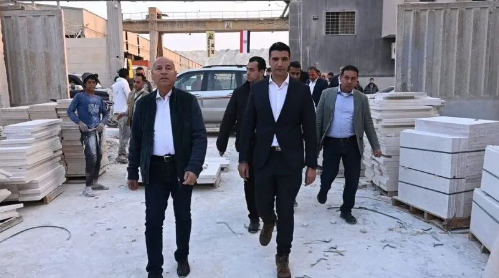
Recently, Egyptian Minister of Industry Khaled Hashim, together with Cairo Governor Dr. Ibrahim Saber, conducted a special investigation in the Shaq El-Thoban stone industrial zone in Cairo. They visited five key marble and granite production enterprises and inspected the Mining and Stone Industry Technology Center under the Ministry of Industry. This comprehensive investigation aimed to understand the current production and operation status, development bottlenecks, and core needs of the enterprises, providing guidance for the high-quality development of the industry.
During the investigation, Minister Khaled Hashim clearly stated that the Ministry of Industry will continue to increase its support for the Shaq El-Thoban industrial zone, focusing on optimizing approval processes, simplifying procedures for enterprises, and improving service efficiency. Meanwhile, the minister emphasized the need to accelerate the improvement of infrastructure in the industrial park, including water, electricity, and logistics, and to promote the standardization and legalization of stone processing plants within the jurisdiction that lack legal qualifications. He stressed the importance of integrating these plants into the formal economic system and facilitating their access to technical guidance and policy support to effectively improve product quality and export competitiveness.
The five companies surveyed included industry leaders such as United Marble & Granite and Global Stone, with a total investment exceeding 1.5 billion Egyptian pounds, forming a complete industrial chain integrating mining, processing, and export. These companies’ products are exported to multiple continents, including Europe, Asia, Africa, the Americas, and Australia. Several companies have exports accounting for over 60% of their business, and some achieve 100% export. This has not only generated considerable foreign exchange earnings for Egypt but also directly created thousands of jobs, becoming a vital support for regional economic development and improved livelihoods.
During his visit to the Mining and Stone Industry Technology Center, the Minister highly praised the center’s functional value, pointing out its irreplaceable supporting role in stone research and innovation, mineral resource assessment, and product quality testing. He emphasized that it is a core platform for promoting the transformation of Egypt’s stone industry from “resource advantage” to “technology advantage,” and is of great significance for enhancing the international recognition of Egypt’s industrial minerals and stone products and strengthening market competitiveness. This in-depth research also sent a clear signal from the Egyptian government to accelerate the upgrading of the stone industry cluster, strengthen technological empowerment, and adhere to export-oriented development, injecting strong confidence into the industry’s future development.
As a major player in the global stone industry, Egypt, with its unique resource endowment, occupies an important position in the international stone market, especially in the beige marble sector, where it enjoys an outstanding reputation and has become one of the world’s core suppliers of beige marble. It is understood that Egypt possesses more than 55 varieties of marble and granite, with resources widely distributed, mainly concentrated in the eastern desert, the Red Sea coast, the Sinai Peninsula, and the Aswan region, providing a solid resource guarantee for industrial development.
Among the various types of marble, warm-toned series such as Egyptian Beige, Golden Beige, and Golden Splendor are the most representative. The creamy yellow marble produced in Suez Province, known for its fine texture and warm color, enjoys the reputation of “Egyptian Yellow” in the Chinese market and has become a popular choice in the architectural decoration field. Granite, mainly of varieties such as Aswan Red, Egyptian White Granite, and Suez Green, is widely used in outdoor construction projects due to its hardness, wear resistance, and corrosion resistance. It is worth mentioning that Egyptian stone not only has abundant reserves but also excellent physical properties. For example, Zaafarana marble has a compressive strength exceeding 100MPa and extremely low water absorption, giving it inherently strong international market competitiveness.
A significant industrial cluster effect is a prominent feature of the Egyptian stone industry. The Tjabarni Industrial Zone is the most well-known, housing 60% to 70% of Egypt’s stone processing enterprises, ranking fourth in the world and making it one of the largest stone processing and export bases in Africa. It is reported that Egypt currently has approximately 2,500 stone-related enterprises, employing 100,000 people, with an annual mining capacity exceeding 3.2 million tons, forming a complete industrial ecosystem.
Leveraging its abundant resource reserves, large-scale processing capabilities, and export-oriented industrial policies, Egypt’s stone exports have performed exceptionally well. In the first five months of 2024, exports reached US$198 million, a year-on-year increase of 16%, with export destinations covering 115 countries and regions. Benefiting from the deepening Sino-Egyptian economic and trade cooperation, the Egyptian stone industry has also received strong support from Chinese technology and equipment. Currently, nearly 90% of the machinery and equipment in the Egyptian stone industry comes from China, and 70% of the processing tools use products from Ezhou Diamond, a Chinese company. This Sino-Egyptian industrial synergy continues to empower the upgrading of the Egyptian stone industry.
In recent years, the Egyptian government has prioritized the stone industry as a key export sector, explicitly setting a strategic goal of increasing stone exports to US$1 billion. In the future, Egypt will continue to improve the infrastructure of the Thaiabani Industrial Zone, promote the standardized development of enterprises, strengthen the enabling role of the technology center, and leverage its advantages in free trade agreements and RMB direct investment facilitation policies to further enhance product quality and brand influence, promote Egyptian stone to a broader global market, and contribute to the high-quality development of the national economy.